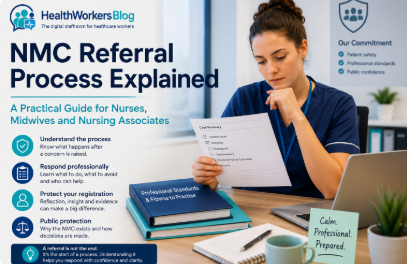
NMC referral process explained: A calm guide for Nurses and Midwives
A practical Staffroom guide to understanding what happens when a concern is raised, why the process exists, and how healthcare workers can respond without panic.
The NMC referral process is one of those topics many nurses, midwives and nursing associates hear about with fear, but not always with full understanding. Sometimes people only learn about it when they, a colleague, or someone in their workplace becomes involved in a concern.
That is not the best time to start learning.
A referral to the Nursing and Midwifery Council does not automatically mean someone is guilty, unsafe, or about to be struck off. It means a concern has been raised and the regulator may need to decide whether that concern affects the person’s fitness to practise.
The NMC says it investigates concerns about a nurse, midwife or nursing associate’s fitness to practise where the concern could place patients at risk or negatively affect public confidence in the professions.
This article is not legal advice. It is a calm, professional guide for healthcare workers who want to understand the process, reduce panic, and know why early support, evidence and reflection matter.
Why the NMC Referral Process Exists
The NMC referral process is not designed simply to punish people for mistakes. Its wider purpose is public protection.
That includes protecting patients, maintaining public confidence in nursing and midwifery, and upholding professional standards. This is important because healthcare workers hold trusted roles. What happens in practice, documentation, communication, honesty, safeguarding and professional conduct can affect that trust.
A referral may involve a serious clinical incident. It may involve repeated concerns over time. It may relate to conduct outside work, social media behaviour, criminal matters, dishonesty, health concerns, professional boundaries, or documentation.
The important thing is this: a referral is the start of a process, not the final outcome.
What Fitness to Practise Actually Means
Fitness to practise does not mean a nurse, midwife or nursing associate must be perfect. Healthcare is complex, and mistakes can happen even to experienced professionals.
The real question is whether the professional can practise safely, effectively and with the level of trust expected of someone on the register.
For example, a one-off mistake where someone is open, reflective, supported and able to show learning may be viewed differently from repeated unsafe practice, dishonesty, poor insight, or behaviour that continues to place people at risk.
This is why the NMC referral process looks beyond the incident itself. It considers context, risk, evidence, learning and whether the concern remains current.
How a concern may reach the NMC
A concern can come from different sources. It may be raised by an employer, patient, relative, colleague, police, another regulator, or sometimes by the professional themselves.
Some concerns are handled locally by employers. Others may be referred to the NMC because they appear serious enough to raise questions about public safety, professional standards or public confidence.
Common referral themes may include medication errors, poor documentation, safeguarding failures, professional boundary concerns, dishonesty, social media conduct, criminal cautions or convictions, repeated poor performance, or failure to escalate concerns.
But context matters. A concern raised in a chaotic ward, during severe staffing pressure, or after poor local supervision may need to be understood differently from deliberate misconduct or repeated unsafe behaviour.
The first stage: Screening
Before a full investigation happens, the NMC considers whether the concern is something it should deal with as a regulator.
This stage matters because not every workplace issue should become a full NMC case. Some matters may be better managed locally through supervision, training, reflection, performance support or local investigation.
The NMC’s screening guidance looks at whether there is a written concern about someone on the register and whether there may be an ongoing risk to public safety, public confidence or professional standards requiring regulatory action.
For the person involved, this stage can feel unsettling because information may be limited. The temptation is to panic, over-explain, message people, or try to defend yourself immediately.
That is usually not wise.
A better first response is to pause, read carefully, keep records and seek advice.
What to do if you are told about an NMC referral
If you are told a referral has been made, the first thing to protect is your professional response.
Do not respond in anger. Do not delete emails, messages, screenshots or documents. Do not discuss confidential patient information in group chats. Do not post about the issue online. Do not try to influence witnesses.
Instead, take a calm and organised approach:
- Read the correspondence carefully.
- Contact your union, professional body or legal adviser early.
- Write a factual timeline while events are still fresh.
- Keep relevant emails, policies, rotas, reflections and training records.
- Maintain patient and workplace confidentiality.
- Avoid emotional or defensive written responses before getting advice.
This is not about hiding anything. It is about responding properly.
A poorly written response can create problems. A calm, factual and reflective response can help show maturity and professionalism.
The investigation stage
If the NMC decides the concern needs investigation, information may be gathered from different sources. This could include employer reports, witness statements, clinical records, local policies, investigation documents or the registrant’s own response.
The investigation is not just about collecting negative information. It is also an opportunity to understand context, risk, learning and what has changed since the concern arose.
Once the investigation is completed, case examiners decide whether there is a case to answer and what should happen next. The NMC explains that case examiners make this decision after the investigation team has completed its work.
This is why the quality of your reflection, evidence and support can matter. The process is not only asking, “What happened?” It is also asking, “What is the current risk now?”
Why insight matters so much
One of the biggest words in the NMC referral process is insight.
Insight means more than saying sorry. It means showing that you understand the concern, the risk involved, the professional standard expected, and what you have done to reduce the chance of it happening again.
The NMC says evidence of insight and steps taken to strengthen practice will usually be central when deciding whether someone’s fitness to practise is currently impaired.
Good insight may sound like:
“I understand why this was a concern.”
“I can see the potential risk to the patient, colleague, organisation or public confidence.”
“I have reflected on what happened and why.”
“I have taken steps to strengthen my practice.”
“I can evidence what I have changed.”
Poor insight often looks like denial without explanation, blaming everyone else, minimising the concern, or saying “I have learned” without showing what has changed.
What strengthened practice looks like
Strengthened practice is the evidence that learning has moved beyond words.
For example, if the concern involved documentation, strengthened practice might include training, supervision, feedback, audits of your notes, and examples of improved record keeping.
If the concern involved communication, it might include reflective supervision, feedback from colleagues, communication training, cultural awareness work, or evidence that concerns have not repeated in similar settings.
If the concern involved medication safety, it might include medicines management training, supervised practice, competency reassessment and evidence of safer checking habits.
The point is simple: do not only say you have improved. Show how you have improved.
Common mistakes that make things worse
Some mistakes happen because people are frightened.
One common mistake is ignoring NMC correspondence because it feels overwhelming. Silence rarely helps.
Another is sending a long emotional statement before getting advice. You may feel you are explaining yourself, but if the tone is defensive, inconsistent or blaming, it may not help your case.
A third mistake is discussing the situation too widely. WhatsApp comments, screenshots, social media posts and workplace gossip can become part of a wider concern.
Another mistake is assuming resignation ends everything. Leaving a job does not automatically stop a regulatory process if the concern is serious enough.
The safest approach is calm, supported and evidence-based.
Possible outcomes
The outcome of the NMC referral process depends on the seriousness of the concern, the evidence, the level of current risk, the professional’s insight, and whether practice has been strengthened.
Some cases may close with no further action. Others may result in advice, a warning, undertakings, conditions of practice, suspension, or in the most serious cases, striking off.
The NMC’s sanctions guidance explains that insight and strengthened practice can be mitigating because they may suggest the professional is less likely to pose a future risk to public safety, although this may carry less weight where the concern is about public confidence or professional standards.
This is why every case is different. The process considers the facts, the context and what has happened since.
A note for overseas healthcare workers
For overseas-trained nurses, midwives and nursing associates, the NMC referral process may feel especially frightening.
You may be navigating a new healthcare system, a different communication style, unfamiliar documentation standards, visa-related fears, and uncertainty about what is expected in UK practice.
That does not remove professional responsibility, but it does show why education and support are important.
If you are new to UK practice, learn local escalation processes, safeguarding expectations, medicines policies, documentation standards, incident reporting and professional boundaries. Ask questions early. Silence can sometimes be misread as confidence when it is actually uncertainty.
Staffroom takeaway
The NMC referral process is serious, but it should not be surrounded by panic and rumours.
A referral does not automatically mean guilt. It means a concern has been raised and may need to be assessed.
The strongest response is usually calm, supported, factual and reflective. Keep records. Seek advice early. Maintain confidentiality. Show insight where appropriate. Evidence your learning. Avoid emotional responses and do not try to manage the process alone.
Most importantly, remember that professionalism still matters even when you feel afraid, misunderstood or hurt.
Safety note
This article is for general professional education only. It is not legal advice, union advice or regulatory representation.
If you are involved in an NMC referral process, contact your union, defence organisation, legal representative or appropriate professional adviser as early as possible.